 ™
™The Science of Composting
Every detail of the Rawbin has been engineered to turn organic leftovers into living soil food. Explore the biological, chemical, and mechanical physics.
Science of Composting
Leave food scraps in a closed container for a week and you get a smelly mess. Give the same scraps the right mix of air, moisture, and microbes, and they turn into something that looks and smells like rich, dark soil. Rawbin is built around getting that second outcome, every time — automatically.
What's actually happening inside
Composting is really just food for billions of microorganisms. Like any living thing, they need carbon for energy, nitrogen to build their cells, and oxygen to breathe. Get that balance right, and they get to work fast — breaking down sugars and starches first, then moving on to tougher stuff like proteins, fats, and plant fibre.
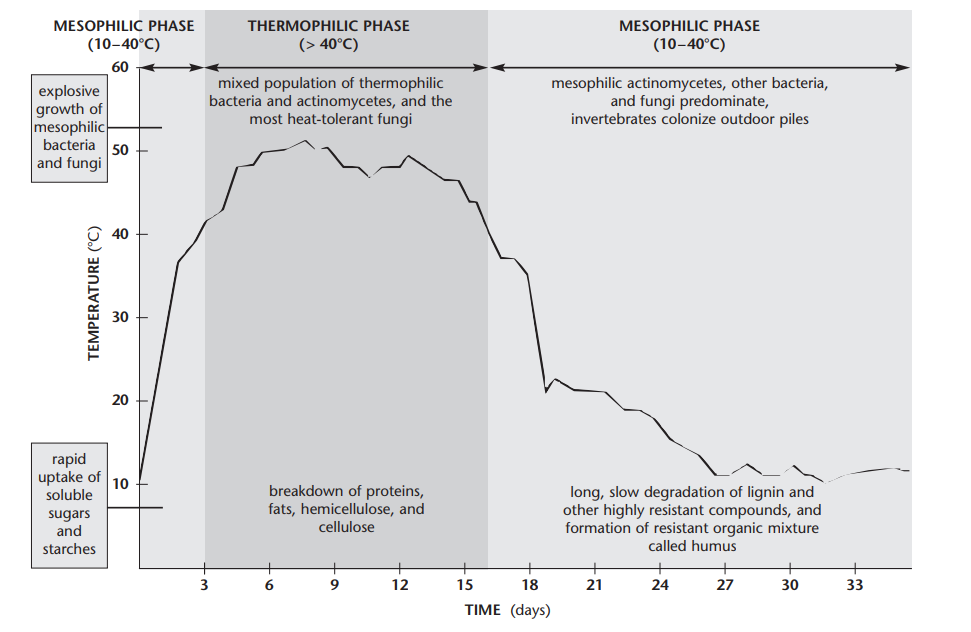
As they feed, this microbial activity generates heat. Left to run its course, a compost pile moves through three temperature stages:
- Warm-up — everyday microbes rapidly consume the easy stuff, and the pile starts heating up.
- Peak heat — once things get hot enough, heat-loving microbes take over, breaking down tougher compounds and pushing out disease-causing organisms and weed seeds in the process.
- Curing — as food runs low, temperatures drop and the mix settles into a slower, final stabilization stage that produces mature, usable compost.
More heat isn't automatically better, either. High temperatures help wipe out pathogens, but push things too far and you start killing off the very microbes doing the work. The target is a window — hot enough to move fast, not so hot the workforce burns out.
Aeration & Odor Mitigation
Why does compost sometimes smell?
Fresh food waste contains plenty of moisture and nutrients. When oxygen cannot reach all parts of the material, anaerobic pockets can form. In these oxygen-starved zones, a different group of microorganisms takes over and produces compounds associated with unpleasant odours, including ammonia, hydrogen sulfide, and other volatile organic compounds.
Good composting is aerobic composting — giving the right microbes enough oxygen to do their work.
Placeholder
How oxygen helps control odour
- As nitrogen-rich organic matter decomposes, ammonia can be released.
- In the presence of oxygen, specialised microorganisms convert ammonia into nitrite and then nitrate.
The science behind nitrogen transformation
The key insight: oxygen does not simply mask odour. It changes the biological pathway through which decomposition occurs.
+ 2H2O
Why most home composting fails
Getting this right by hand is harder than it sounds, because it means balancing several things at once — continuously, not just at setup:
1Carbon and nitrogen
Need to stay in roughly the right ratio — too much nitrogen and you get a smelly, ammonia-heavy mess; too little and decomposition crawls.
2Water and air
Have to share space, not compete for it. Microbes need a moist film around every particle to stay active, but they also need open air pockets to breathe. Too dry, and they slow down. Too wet, and water floods those air pockets, oxygen stops moving through, and the pile turns anaerobic — which is what causes that rotten-egg smell.
3Airflow
Air has to keep moving, not just get added once. Microbes use up oxygen continuously as they work, so a weekly turn isn't enough to keep a pile aerobic — what actually matters is sustained airflow.
4Heat retention
Depends on having enough mass and insulation — too small a pile or bin loses heat too quickly to ever reach the temperatures needed for fast, safe decomposition.
This is why so many home compost bins stall out, go smelly, or just never get hot enough to work — they're static systems trying to keep pace with a process that needs constant, real-time balancing.
Ready to Decentralize Your Waste?
Eliminate methane, cut municipal logistics, and start nourishing your home plants with Rawbin.